Big Bass Bonanza RTP & Volatility Explained
This article explains what RTP and volatility mean in Big Bass Bonanza, why you often see the phrase “up to 96.71%,” and how to interpret outcomes realistically. It’s written for readers with basic slot knowledge, avoids slang, and focuses on practical understanding.
US 18+
Play responsibly
Only operators licensed by DGOJ
What RTP and volatility mean in practice
-
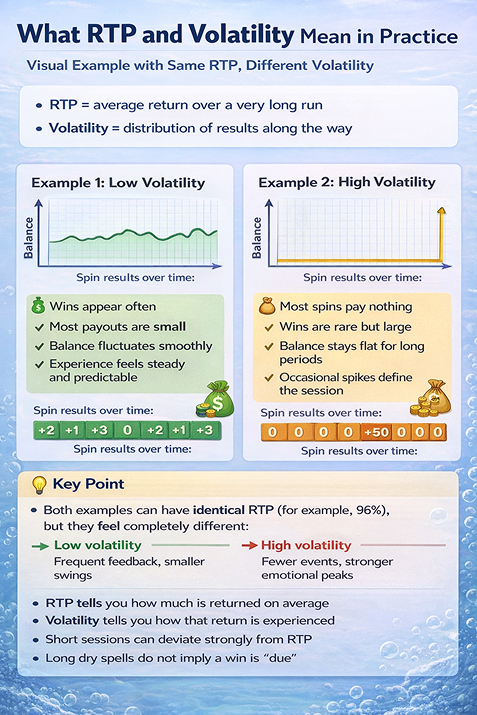
RTP (Return to Player) is a long-run statistical indicator showing the share of total bets theoretically returned to players as wins. It is not a prediction for a single session. Volatility describes how wins are distributed: higher volatility usually means rarer but larger wins; lower volatility means more frequent but smaller wins. In Big Bass Bonanza, the perception of volatility is strengthened by how its key events appear and how often visual cues occur.
What RTP and volatility mean in practice
RTP (Return to Player) is a long-run statistical indicator showing the share of total bets theoretically returned to players as wins. It is not a prediction for a single session.
Volatility describes how wins are distributed: higher volatility usually means rarer but larger wins; lower volatility means more frequent but smaller wins. In Big Bass Bonanza, the perception of volatility is strengthened by how its key events appear and how often visual cues occur.
Why “up to 96.71%” doesn’t guarantee what you’ll see
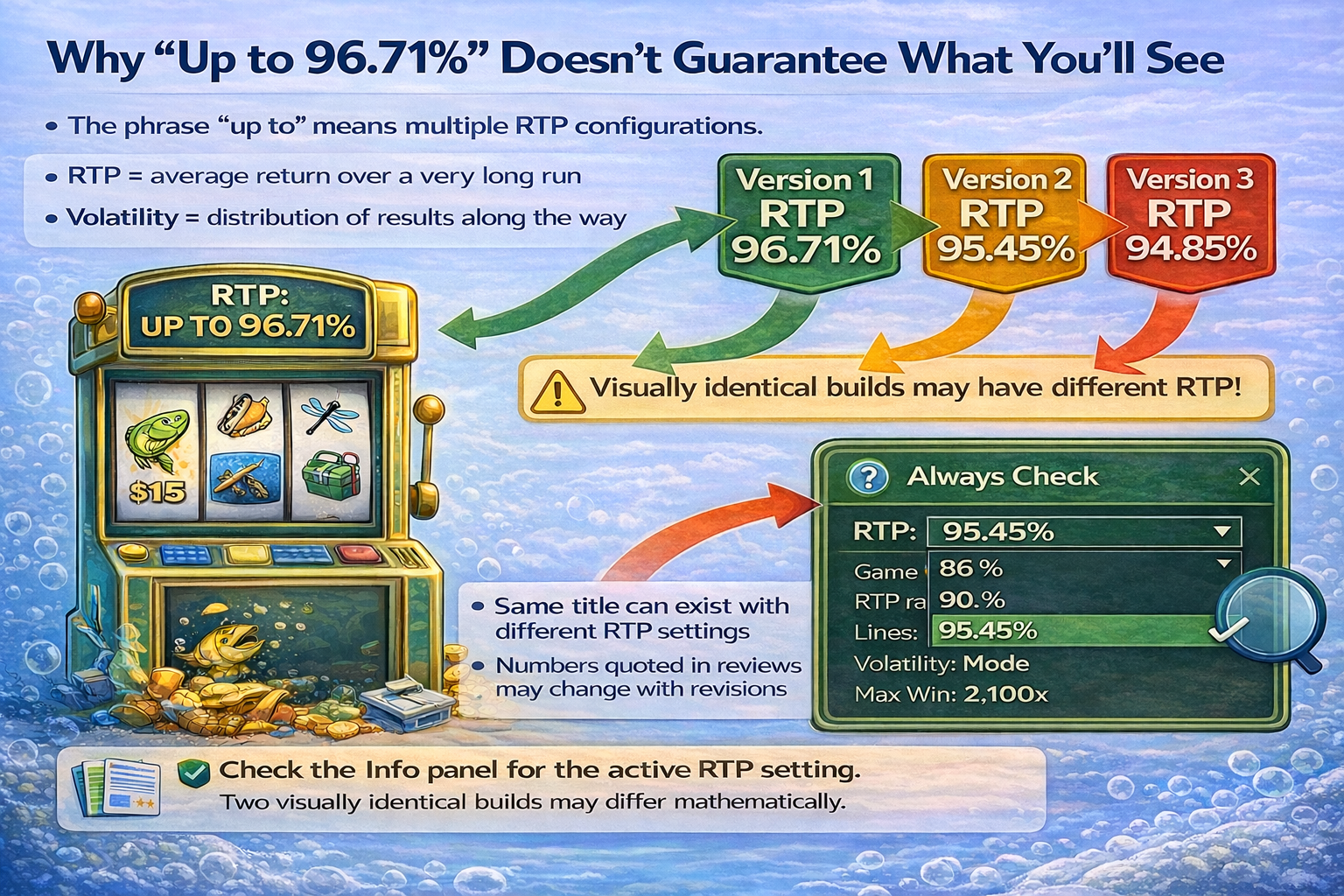
“Up to” typically signals multiple RTP configurations. The same title can exist with different settings, and the exact variant in your lobby depends on the version and the operator’s choice. Two visually identical builds may differ mathematically.
Over time, releases receive reissues or revisions. Numbers quoted in reviews may refer to a different revision. Exact values may vary by version and operator, so it’s reasonable to check the in-game information panel.
How versions within the Big Bass family can feel different
The series includes several entries and reinterpretations. Differences affect the rhythm: in some versions, base-game stretches feel “quieter” with occasional spikes; in others, mid-size wins appear a bit more often, with fewer long dry spells.
Even without formulas, you’ll notice that paytables and event frequencies vary between versions, affecting how winning and non-winning spins cluster during a session.

Common misconceptions
-
Expecting RTP to “show up” in short play. RTP is built on huge datasets, not on one evening.
-
“Hot” or “cold” cycles. Each spin is statistically independent; past spins don’t load future ones with extra probability.
-
Reading “near-misses” as a signal. Visual near-misses are part of UX and don’t change the odds of the next spin.
What you actually control
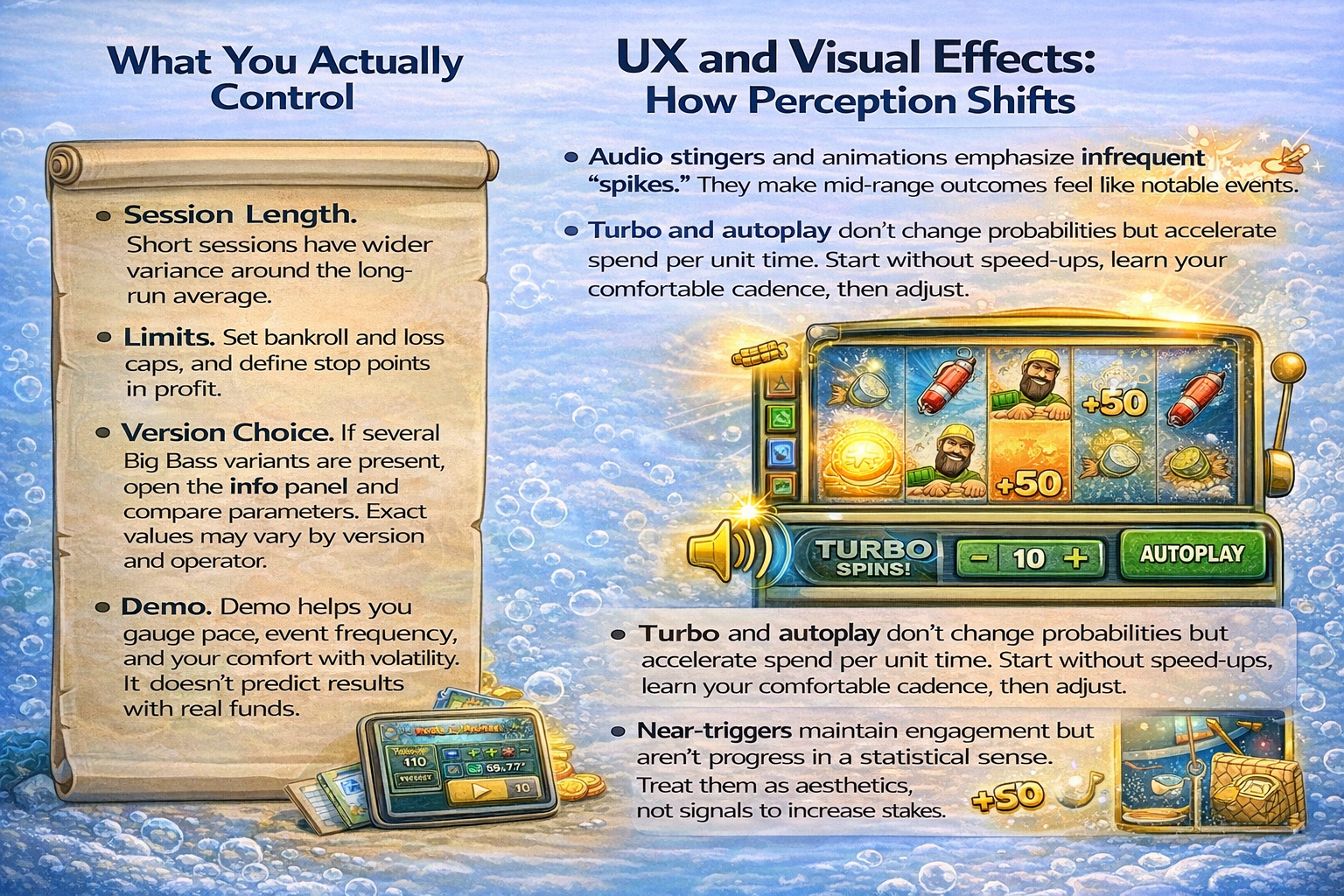
Session length. Short sessions have wider variance around the long-run average.
Limits. Set bankroll and loss caps, and define stop points in profit.
Version choice. If several Big Bass variants are present, open the info panel and compare parameters. Exact values may vary by version and operator.
Demo. Demo helps you gauge pace, event frequency, and your comfort with volatility. It doesn’t predict results with real funds.
UX and visual effects: how perception shifts
Audio stingers and animations emphasize infrequent “spikes.” They make mid-range outcomes feel like notable events.
Turbo and autoplay don’t change probabilities but accelerate spend per unit time. Start without speed-ups, learn your comfortable cadence, then adjust.
Near-triggers maintain engagement but aren’t progress in a statistical sense. Treat them as aesthetics, not signals to increase stakes.
Performance and adaptability
Modern versions are mobile-optimized, but performance depends on device and connection. Frame drops affect perceived rhythm, not math.
On weaker devices, disable extra effects if possible and avoid parallel loads. Portrait vs landscape may change layout and tap comfort, not probabilities.
Brief evolution of the series
Big Bass grew from a simple thematic idea into a family of variations. Releases tweaked tempo, visual emphasis, and event structure while keeping the core metaphor.
The industry also adopted flexible RTP settings across platforms. Two similar entries in different lobbies can differ in theoretical settings. Exact values may vary by version and operator, so verify them inside the game before you start.
For comparison: cluster-based games (e.g., Jammin’ Jars-style mechanics) distribute wins differently than line-based models, changing how volatility feels at the same nominal level.



Interpreting your session without self-deception
Define success criteria in advance: pure monetary outcome or number of “events” seen within a set time. If you prefer steady pacing, pick versions that feel more active in demo and avoid turbo early on.
Screenshots are selective evidence. Base your expectations on your own comfort and limits, not on highlight reels.
If your loss limit is reached, stop. “Chasing” outcomes conflicts with how volatility clusters results.
A quick pre-play checklist:
-
Open the info panel and check parameters. “Up to” is a ceiling; your instance may differ. Exact values may vary by version and operator.
-
Test the rhythm in demo. If long dry spells frustrate you, choose a version that feels more event-dense.
-
Decide on speed features (turbo/autoplay) beforehand and use stricter limits if you enable them.

Takeaways
-
RTP is a long-run indicator, not a short-term forecast. Volatility shapes the distribution’s “edges,” which you feel as calm stretches and occasional spikes.
-
“Up to 96.71%” signals range, not a guarantee. Verify parameters in the game, manage time and bankroll, and align pace with your comfort.
-
Treat a short session as one small slice of a large distribution. That mindset helps you keep the experience controlled and predictable in feel, even when outcomes vary.
FAQ
Multiple RTP configurations exist. Platforms choose variants. Reissues also occur. Exact values may vary by version and operator.
It mirrors interface and rhythm. Math depends on the implementation in your lobby. Demo doesn’t predict future outcomes.
No. RTP is long-run. Short-run deviations, amplified by volatility, are normal.
No. They change only the pace and spend per minute.
From a probability standpoint, spins are independent. “Right time” is about your time and limit management.
UX emphasizes them to maintain engagement. They do not increase the next spin’s chances.
Compare info panels across visible variants. Even with higher stated RTP, short sessions remain governed by volatility.
Pick versions that feel smoother in demo, avoid early turbo, and keep tighter session limits.